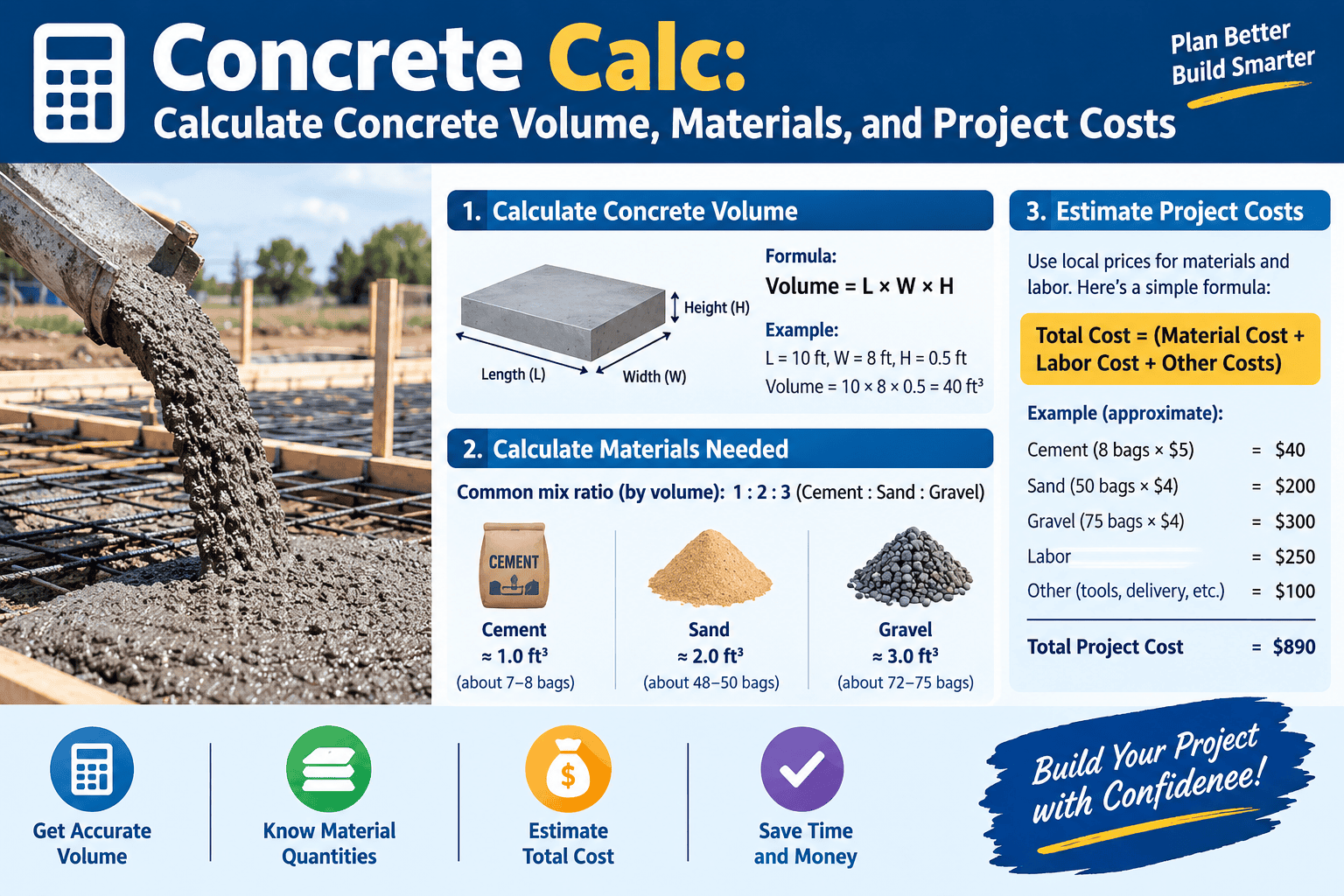
Planning a concrete project can feel difficult when you do not know how much material you need. You might be building a driveway, patio, garden path, floor, or foundation. Each project needs the right amount of concrete to stay strong and last longer. Buying too little can delay your work. Buying too much can waste money and materials. A concrete calc makes this process easier.
This helpful tool estimates the amount of concrete needed for your project. You enter a few measurements, such as length, width, and thickness. The calculator then estimates the required volume. Many tools also help you estimate material quantities and total costs. You can use the results to plan your budget and prepare for delivery.
You do not need advanced math skills to understand the process. With simple measurements and basic formulas, you can make better decisions before construction begins. This guide explains how concrete calculations work, how to use them, and how to avoid common mistakes.
What Is a Concrete Calc?
A concrete calc is an online tool that estimates the concrete needed for a construction project. It uses your measurements to calculate volume. Some calculators also estimate the number of concrete bags, material quantities, and expected costs.
For example, imagine you want to build a small backyard patio. You measure its length, width, and planned thickness. You enter these values into the calculator. It estimates how much concrete the patio will require.
This information helps you prepare before buying supplies. You can compare bagged concrete with ready-mix delivery. You can also estimate expenses and reduce unnecessary waste. However, the result depends on accurate measurements and suitable project settings.
A calculator provides an estimate rather than a guaranteed final quantity. Ground conditions, uneven surfaces, and changes in thickness can affect your actual needs. Always review your measurements before placing an order.
Why Should You Use a Concrete Calc?
Concrete projects require careful planning. Even a small measurement error can change the amount of material you need. A concrete calc helps reduce these problems by turning basic dimensions into useful estimates.
Here are some important benefits:
- Saves time: Calculate concrete volume without doing lengthy manual calculations.
- Controls costs: Estimate material needs before visiting a supplier.
- Reduces waste: Avoid ordering much more concrete than necessary.
- Improves planning: Prepare for delivery, mixing, and labor.
- Supports comparisons: Compare different project sizes and material options.
- Helps beginners: Understand concrete quantities without advanced construction knowledge.
For example, a homeowner planning a walkway can calculate the volume before buying concrete bags. A contractor can estimate the concrete needed for several slabs. Both can use these figures to prepare budgets and organize work.
Remember that accurate results begin with accurate measurements. Check every dimension and use the correct units. For structural projects, follow approved plans and seek professional advice when needed.
How to Calculate Concrete Volume
Concrete volume tells you how much space the concrete will fill. Most rectangular slabs require three measurements: length, width, and thickness.
Use this simple formula:
Concrete volume = Length × Width × Thickness
Make sure all three measurements use the same unit. For example, you can measure everything in feet to calculate cubic feet.
Suppose you have a patio that measures 10 feet long, 8 feet wide, and 4 inches thick. First, convert the thickness into feet.
4 inches ÷ 12 = 0.333 feet.
Now multiply the measurements:
10 × 8 × 0.333 = 26.64 cubic feet.
Convert cubic feet into cubic yards by dividing the result by 27.
26.64 ÷ 27 = approximately 0.99 cubic yards.
Therefore, the patio requires about 0.99 cubic yards of concrete before adding any extra allowance. In practice, you should confirm the final quantity with your supplier and account for the actual site conditions.
How to Measure Your Project Correctly
Good measurements are the foundation of a useful concrete estimate. Before using a concrete calc, measure the area carefully and record every dimension.
For a rectangular slab, measure the longest side for length. Measure the distance across the shorter side for width. Then determine the planned concrete thickness from your project design.
Use a reliable tape measure and check each dimension twice. If the ground slopes or has uneven areas, determine how the slab thickness will be maintained. Do not assume that every part of the ground has the same level.
For circular projects, measure the diameter or radius. For example, a circular concrete pad requires a different formula from a rectangular patio. For steps, footings, or unusual shapes, calculate each section separately and add the volumes together.
Keep your measurements in one unit system. Mixing inches, feet, meters, and centimeters without conversion can produce incorrect results. If you are unsure about the required thickness, consult your project plans or a qualified professional before ordering materials.
Concrete Calc for Cubic Feet, Cubic Yards, and Cubic Meters
Concrete is commonly measured in cubic feet, cubic yards, or cubic meters. The correct unit often depends on your location and supplier.
In the United States, ready-mix concrete is commonly sold by the cubic yard. Other markets may use cubic meters. Bagged concrete usually lists its expected yield on the packaging.
These conversions are useful when checking your results:
| Measurement | Conversion |
| 1 cubic yard | 27 cubic feet |
| 1 cubic meter | Approximately 35.315 cubic feet |
| 1 cubic meter | Approximately 1.308 cubic yards |
| 1 cubic foot | Approximately 0.0283 cubic meters |
For example, suppose your calculation gives 54 cubic feet. Divide 54 by 27 to get 2 cubic yards.
A concrete calc can handle these conversions automatically when you select the correct units. Still, check the displayed unit before ordering materials. A result of 2 cubic feet is very different from 2 cubic yards. Understanding the units helps prevent expensive mistakes.
Concrete Calc for a Driveway, Patio, or Floor
Different projects require different concrete quantities. The calculation method depends on the shape and dimensions of the area.
A driveway may cover a large rectangular area. A patio may have a simple shape or several connected sections. An indoor floor usually requires measurements based on the room’s dimensions and planned slab thickness.
Consider a rectangular driveway measuring 20 feet long and 12 feet wide. Suppose its planned thickness is 5 inches.
Convert the thickness into feet:
5 ÷ 12 = 0.417 feet.
Calculate the volume:
20 × 12 × 0.417 = approximately 100 cubic feet.
Convert this result into cubic yards:
100 ÷ 27 = approximately 3.70 cubic yards.
This estimate does not include extra material for waste or uneven ground. The required thickness also depends on the intended use, soil conditions, loads, and local building requirements.
Do not copy a driveway thickness for every other project. A garden path, garage floor, and vehicle driveway may need different designs. Follow the project specifications before calculating your final order.
How Many Concrete Bags Do You Need?
Bagged concrete is useful for small projects, repairs, fence posts, and garden features. The number of bags depends on the total concrete volume and the yield printed on each bag.
The basic formula is:
Number of bags = Required concrete volume ÷ Yield per bag
Make sure both measurements use the same units.
For example, imagine your project requires 2 cubic feet of concrete. Each bag produces 0.6 cubic feet after mixing, according to its label.
2 ÷ 0.6 = 3.33 bags.
You cannot buy one-third of a standard bag, so you would need at least 4 bags. You may need additional material if the area is uneven or some concrete is lost during placement.
Different bag sizes produce different volumes. Never assume that every 40-pound, 60-pound, or 80-pound bag has the same yield. Check the manufacturer’s packaging before purchasing.
A concrete calc that supports bag estimates can save time. Enter the required volume and select the correct bag yield. For larger projects, compare the cost and practicality of bagged concrete against ready-mix delivery.
Estimating Cement, Sand, and Gravel
Concrete commonly contains cement, water, and aggregates such as sand and gravel. Cement acts as the binder that helps the mixture harden. Sand fills smaller spaces, while gravel provides larger aggregate particles.
The required quantities depend on the concrete mix design. Different projects need different strength levels, workability, and durability. A simple cement-to-sand-to-gravel ratio can provide a rough estimate, but it does not replace an approved mix design.
For example, a traditional nominal mix may use a stated proportion of cement, sand, and coarse aggregate. However, the final quantities also depend on moisture, aggregate grading, water content, and material density.
Adding too much water can weaken the finished concrete. Using unsuitable aggregates can also affect performance. For structural work, use a specified mix from a qualified supplier or follow the engineer’s instructions.
A concrete calc may estimate the volume of the finished concrete without calculating each ingredient separately. If you need ingredient quantities, choose a calculator designed for mix proportions. Check its assumptions before using the results to buy materials.
How to Estimate Concrete Project Costs
Knowing the concrete volume helps you build a realistic budget. However, the total cost includes more than the concrete itself.
A useful cost estimate may include:
- Concrete material or delivery charges
- Cement, sand, and gravel for site mixing
- Reinforcement, where required
- Formwork and support materials
- Surface preparation and excavation
- Labor and equipment rental
- Pumping or delivery surcharges
- Waste allowance and site cleanup
For example, suppose your project needs 3 cubic yards of ready-mix concrete. If the supplier quotes $150 per cubic yard, the material subtotal is $450.
This figure excludes delivery fees, taxes, labor, and other project expenses. Your final price may also change with location, mix specifications, and order size.
A concrete calc with a cost feature can help you compare estimates. Enter the local price per cubic yard or cubic meter. Add separate expenses for labor and other supplies to build a fuller budget.
Always request a current quote from your supplier. Online prices may not reflect your area’s actual rates.
Adding Extra Concrete for Waste
Your calculated volume represents the amount needed to fill the measured space. Real construction projects can require more material than this basic estimate.
Small losses can happen during mixing, pouring, moving, and finishing. The ground may also contain low spots or uneven sections. These factors can increase the amount of concrete needed.
A common planning approach is to add an allowance of around 5% to 10%. The right amount depends on the project’s shape, site conditions, and how accurately the area can be prepared.
For example, suppose your calculation gives 4 cubic yards. A 5% allowance adds 0.20 cubic yards. The estimated order becomes 4.20 cubic yards.
A 10% allowance adds 0.40 cubic yards, producing a total of 4.40 cubic yards.
These percentages are planning examples, not fixed rules. Discuss the appropriate allowance with your concrete supplier or contractor. Ordering extra concrete also creates a disposal concern if the material is not needed, so avoid adding a large amount without a reason.
Common Mistakes to Avoid When Calculating Concrete
Even a helpful calculator cannot correct incorrect information. Small mistakes in measurements or units can create large differences in the final estimate.
Watch out for these common problems:
Forgetting to convert thickness: If your slab is 4 inches thick, do not enter 4 feet. Convert inches into feet when using feet for length and width.
Mixing measurement units: Use consistent units throughout the calculation.
Measuring only once: Recheck length, width, and thickness before ordering.
Ignoring unusual shapes: Divide complex areas into smaller shapes and add their volumes.
Using the wrong bag yield: Check the expected yield on the product label.
Forgetting extra costs: Delivery, labor, reinforcement, and preparation can increase the budget.
Assuming the estimate is exact: Actual site conditions may change the quantity needed.
Review these details before confirming your order. If the project involves structural footings, retaining walls, or major load-bearing work, use approved plans and professional guidance. Correct calculations support better planning, but they do not replace proper engineering.
Tips for Getting the Best Results From a Concrete Calc
Start by identifying the exact area you want to fill. Decide whether you are measuring a slab, footing, column, step, or another shape. Select a calculator that supports that shape and the units you use.
Measure the dimensions carefully and enter the thickness in the correct unit. Review the calculated volume before moving to the next step. If your project has several sections, calculate them separately and add the results.
Next, check whether the tool includes waste, bag yield, material costs, or delivery charges. Some calculators estimate only volume. Others provide additional features that support purchasing decisions.
Compare the final quantity with your drawings or contractor’s estimate. If the numbers differ greatly, check the measurements and conversions. You can also ask your supplier to review the quantity before placing an order.
For the most reliable planning, keep a written record of your measurements, mix requirements, and quoted prices. This simple habit makes it easier to compare options and identify errors before work begins.
Concrete Calc for Small DIY and Large Construction Projects
A concrete calculator can support both small home improvements and larger construction jobs. Its usefulness depends on selecting the right calculation method for the project.
For a small garden path, you may only need to calculate a thin rectangular slab. For fence posts, you may need the volume of several cylindrical holes. For a larger floor, you may need to calculate multiple sections and consider reinforcement and site preparation.
Large projects require more detailed planning. Concrete delivery schedules, placement equipment, labor, weather, and finishing time can affect the work. A simple volume estimate cannot manage these issues by itself.
For DIY projects, a calculator is a useful starting point. It helps you understand material quantities and prepare a shopping list. For major structural projects, use the construction drawings, approved mix specifications, and advice from qualified professionals.
No matter the project size, the same principle applies: accurate measurements lead to better estimates. Check your results before buying materials, and confirm unusual requirements with your supplier.
Biography Table: Concrete Calc at a Glance
The following table provides a detailed overview of a concrete calc, including its purpose, uses, inputs, and limitations.
| Detail | Information |
| Name | Concrete Calc |
| Category | Construction and measurement calculator |
| Main purpose | Estimate concrete volume and material needs |
| Primary users | Homeowners, DIY builders, contractors, and construction planners |
| Main inputs | Length, width, thickness, diameter, or depth |
| Common outputs | Cubic feet, cubic yards, cubic meters, and estimated bag quantities |
| Additional features | Material cost estimates and waste allowances |
| Common applications | Driveways, patios, floors, walkways, footings, and slabs |
| Main formula for rectangular slabs | Length × Width × Thickness |
| Common volume units | Cubic feet, cubic yards, and cubic meters |
| Required preparation | Accurate measurements and correct unit conversions |
| Main benefit | Faster quantity estimates and improved material planning |
| Main limitation | Results depend on measurements and calculator assumptions |
| Important safety note | Structural designs and mix specifications require suitable professional guidance |
This is a functional overview rather than the biography of a person or company. Different online calculators may offer different features. Check the tool’s instructions to understand exactly what its results include.
Conclusion
A concrete calc makes construction planning simpler by estimating the volume of concrete required for your project. It can help you plan a patio, driveway, walkway, floor, or other concrete feature. With accurate measurements, you can estimate quantities, compare material options, and prepare a more useful budget.
Start by measuring the project carefully. Convert all dimensions into consistent units. Calculate the volume, review the result, and consider a suitable allowance for site conditions. If you are buying concrete bags, check the yield printed on each package. For ready-mix orders, confirm the quantity and price with your supplier.
Remember that a calculator provides an estimate, not a replacement for professional design. Structural projects need suitable specifications and careful planning.
Before starting your next project, calculate the required volume and check your material list. A few minutes of preparation can help reduce waste, control expenses, and make your concrete work easier to manage.
Frequently Asked Questions
1. What is a concrete calc used for?
A concrete calc estimates the amount of concrete needed for a project. You enter measurements such as length, width, and thickness. The tool calculates the volume in cubic feet, cubic yards, or cubic meters. Some tools also estimate concrete bags and material costs.
2. How do I calculate concrete for a slab?
Multiply the slab’s length by its width and thickness. Make sure all measurements use the same unit. For a result in cubic yards, divide the cubic-foot volume by 27. Consider site conditions and a suitable extra allowance before ordering.
3. How much concrete do I need for a 10-by-10 slab?
The answer depends on the slab’s thickness. At 4 inches thick, a 10-by-10-foot slab needs about 33.3 cubic feet, or 1.23 cubic yards, before any extra allowance. Confirm the planned thickness and actual site measurements before purchasing concrete.
4. Can a concrete calc estimate the number of bags?
Yes, if the calculator includes a bag estimator. It divides the required concrete volume by the yield of each bag. Always check the packaging because different bag sizes and products can produce different amounts of mixed concrete.
5. Does a concrete calc include labor and delivery costs?
Not always. Many calculators estimate concrete volume only. Some include optional pricing features. For a realistic budget, check material prices and add delivery, labor, equipment, reinforcement, and preparation costs separately when necessary.
6. How much extra concrete should I order?
A planning allowance of around 5% to 10% is sometimes used. The right amount depends on measurement accuracy, ground conditions, and project shape. Ask your supplier or contractor for advice, especially when ordering a large quantity. Avoid ordering excessive material without a clear reason.