Artificial intelligence has changed how people write articles, essays, emails, and school assignments. Tools like AI writing assistants can create content in seconds. However, readers and writers often want to know whether a piece of text was written by a human or generated by AI. This is where an AI generated detector can help. It checks writing patterns and estimates whether artificial intelligence may have produced the text.
These tools are useful for students, teachers, bloggers, editors, and website owners. They can provide helpful clues about the possible source of written content. However, their results are not always correct. Human writing can sometimes appear AI-generated, while AI-written text can sometimes pass as human writing. In this guide, you will learn how detection tools work, what their scores mean, and how to use them responsibly. You will also discover practical ways to check content while protecting your originality, accuracy, and personal writing style.
What Is an AI Generated Detector?
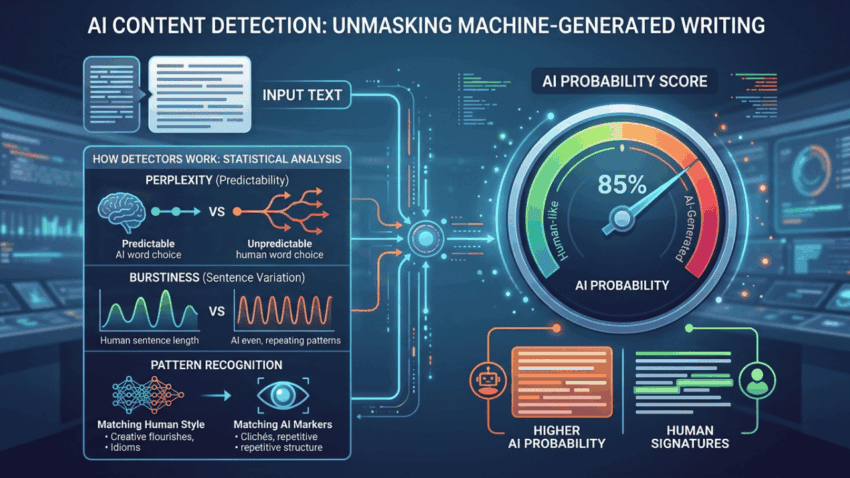
An AI generated detector is an online tool that examines text to estimate whether a human or an artificial intelligence system produced it. These tools study different writing patterns and compare them with patterns learned during their development. Some detectors analyze sentence structure, word choices, repetition, and the predictability of language. They then provide a result that suggests how likely the content is to be AI-generated.
For example, imagine you have written a 1,000-word blog post. You paste the text into a detection tool, and it reports that some sections resemble AI-generated writing. This result does not prove that AI wrote your article. It simply provides an estimate based on the tool’s analysis. A reliable review should also consider your writing process, research, original ideas, and editing history. Therefore, treat detection results as helpful signals rather than final judgments about authorship.
How Does an AI Generated Detector Work?
Most AI detection tools use machine learning models or other text analysis methods. These systems examine language features that may appear more often in AI-generated content. Their goal is to identify patterns that differ from those commonly found in human writing.
Some tools look at how predictable each word is within a sentence. Others examine sentence length, vocabulary, repetition, and changes in writing style. Certain systems may also analyze passages individually instead of evaluating an entire document as one piece. The exact method depends on the provider.
For example, a sentence such as “Technology improves communication around the world” is clear and predictable. However, that does not mean an AI system wrote it. Millions of people could write the same sentence naturally. An AI detector must evaluate broader patterns rather than rely on one phrase. Even then, its judgment can be wrong. The technology is improving, but detecting authorship from text alone remains a difficult task.
Why Are AI Content Detection Tools Important?
AI writing tools are widely used in education, marketing, publishing, and business communication. They can help people organize ideas, correct grammar, and prepare early drafts. At the same time, organizations may need to understand how content was created and whether it follows their rules.
An AI generated detector can support these goals by offering an additional way to review written material. Teachers may use one when discussing writing practices with students. Editors may use it to decide which passages need closer examination. Website owners may use it while reviewing content quality and originality.
However, the tool should never replace human judgment. A detection score cannot reliably establish whether someone cheated, broke a workplace rule, or copied another person’s work. Good writing can come from many different processes. The best approach combines detection results with clear policies, direct communication, source checks, and a review of the actual content.
Who Can Benefit From an AI Generated Detector?
Different people can use AI detection tools for different reasons. Their value depends on the task, the content, and the decisions being made. A blogger might want to understand how an article appears to a detector. A teacher might want to discuss responsible AI use with a class. A business editor might need an extra quality-checking step.
Here are some common users and their needs:
- Students: Understand their institution’s rules about AI-assisted writing.
- Teachers: Support fair discussions about writing and academic integrity.
- Bloggers: Review articles and maintain a consistent editorial process.
- Editors: Identify passages that deserve closer review.
- Businesses: Assess written materials before publication.
- Researchers: Explore the strengths and limits of AI detection technology.
These users should remember that detection tools cannot guarantee accurate authorship judgments. A person who writes independently may still receive a high AI score. Therefore, the tool works best as one part of a larger review process, not as the only source of evidence.
How to Use an AI Generated Detector Step by Step
Using an AI detection website is usually simple. Most tools follow a similar process, although their features and limits may differ. You can often check text without installing software or creating an account.
Follow these steps to get started:
- Choose an AI detection tool with clear explanations of its limitations.
- Read its privacy policy before uploading sensitive material.
- Copy the text you want to examine.
- Paste the text into the detector’s input box.
- Click the available check or analyze button.
- Wait for the tool to process your writing.
- Review the score and any highlighted passages.
- Compare the result with your writing history and other evidence.
For better results, check complete paragraphs instead of judging individual sentences. Some detectors require a minimum amount of text to produce a useful estimate. If the tool identifies certain sections, read those sections carefully. Look for factual problems, repetitive wording, weak explanations, or missing examples. Improve these issues because they affect content quality, regardless of the detection score.
Understanding AI Detection Scores
An AI detection score can look simple, but its meaning is not always obvious. Different providers use different scoring systems. One tool might estimate the likelihood that text is AI-generated. Another might classify passages as likely human-written, likely AI-written, or uncertain.
A score of 70% does not necessarily mean that 70% of the words came from AI. It may represent a model’s estimate, confidence measure, or another provider-specific metric. Always check how the tool defines its score before interpreting the result.
Consider a hypothetical example. One detector labels an article as potentially AI-generated, while another labels the same article as mostly human-written. This disagreement shows why a single result should not be treated as proof. Detection systems may use different training data, thresholds, and methods. Instead of focusing only on percentages, examine the writing itself and review supporting evidence. Clear documentation of your research, drafts, and revisions can provide useful context.
Can an AI Generated Detector Make Mistakes?
Yes, an AI generated detector can make mistakes. No detector can reliably identify the source of every piece of text. Some tools may incorrectly flag original human writing. Others may fail to recognize content produced with AI assistance.
False positives are especially important to understand. A false positive happens when a detector identifies human-written text as AI-generated. This can happen with writing that uses simple language, follows a formal structure, or contains repeated technical phrases. People learning English may also use predictable sentence patterns.
False negatives can occur, too. These happen when AI-generated text receives a result suggesting human authorship. Editing, paraphrasing, and changes in writing style may affect the results, depending on the tool.
For these reasons, avoid using detector scores as the sole basis for serious decisions. If a result raises concerns, ask questions and review available evidence fairly. A careful human assessment is more responsible than making accusations from an automated score alone.
AI Generated Detector vs. Plagiarism Checker
An AI detector and a plagiarism checker serve different purposes. Although both tools can help during content review, they do not answer the same question.
An AI detector estimates whether text resembles content generated by artificial intelligence. A plagiarism checker looks for matching text in sources available to its system. Depending on the provider, those sources may include websites, publications, academic documents, or submitted papers.
For example, a student might write an original paragraph using an AI assistant. A plagiarism checker could find no matching source, while an AI detector might flag the paragraph. Conversely, a person could copy a paragraph from a website without using AI. A plagiarism checker might identify the match, while an AI detector might not flag the text.
Neither result tells the entire story. Originality, accurate citations, authorship, and responsible AI use are separate concerns. For important writing tasks, use the appropriate tools and follow the relevant rules. A strong review process considers all these factors instead of treating them as interchangeable.
How Bloggers Can Use AI Detection Tools
Bloggers often use AI tools to brainstorm topics, organize outlines, and improve drafts. However, published content still needs to offer readers something useful. An AI detector may provide additional information during editing, but it cannot measure every aspect of quality.
Start by checking whether your article answers the reader’s main question. Make sure every section provides helpful information instead of repeating the same ideas. Verify names, dates, statistics, and other factual claims. Add relevant examples and explain difficult concepts in simple language.
You should also develop a consistent editorial process. Keep notes about your research, save drafts, and record important changes. These habits help you understand how an article developed. They are also useful when you need to review your own work later.
Do not rewrite a useful paragraph simply because a detector gives it a high score. Instead, consider whether the paragraph is clear, accurate, original, and relevant. A blog post succeeds when it serves readers well. Detection scores are secondary to those goals.
How Students and Teachers Should Interpret AI Detection Results
Students and teachers should approach AI detection with care. Schools and colleges may have different rules about AI-assisted writing. Some allow certain uses, while others restrict them in specific assignments. Understanding the applicable policy is more important than relying on a detector alone.
Students can protect their work by saving outlines, research notes, early drafts, and revision history. These materials help demonstrate how their ideas developed. They also make writing easier to review and improve.
Teachers should explain assignment rules before students begin writing. If a detection tool raises concerns, a fair response may involve reviewing drafts and discussing the student’s writing process. The student should have an opportunity to explain their work.
A detector score alone cannot prove misconduct. False positives can affect students who write independently, especially those who use simple or highly structured language. A balanced approach supports academic honesty while protecting students from unsupported accusations. Clear rules and open communication help everyone understand what responsible writing means.
How to Choose a Reliable AI Generated Detector
Choosing an appropriate detector requires more than looking for a high accuracy claim. You should consider how the tool explains its results, handles personal information, and supports different types of writing.
Use the following checklist when comparing options:
- Clear scoring: Does the provider explain what its results mean?
- Known limitations: Does it discuss false positives and false negatives?
- Privacy protection: Does it explain how submitted text is stored and used?
- Text compatibility: Can it handle your language and document type?
- Useful reports: Does it identify passages that need closer review?
- Transparent claims: Are accuracy statements supported by clear testing details?
- Fair pricing: Are free limits and paid features explained clearly?
You should also test tools with writing samples whose origins you know. Include different styles and document types when possible. Compare results without assuming that one provider must be correct. A reliable choice is a tool that communicates uncertainty honestly and fits your needs. No product should be trusted simply because its website promises perfect detection.
Privacy and Security When Checking AI-Written Text
Before uploading content, think about what the document contains. An AI detection website may process the text through its own servers. Its privacy practices determine how the information is handled and whether it may be retained.
Avoid uploading confidential business documents, unpublished research, private messages, or personal information without permission. Review the provider’s privacy policy and terms of service. Check whether submitted text is stored, shared, or used to improve its services.
If you only need to test a general writing sample, use text that does not contain sensitive details. For school assignments, follow your institution’s guidance on third-party tools. For workplace documents, ask the appropriate person before sending confidential material to an outside service.
Privacy is important even when a detector is free. A tool’s price does not tell you how safely it handles your information. Choosing services carefully helps protect your work and reduces unnecessary risks.
Common Myths About AI Generated Detection
Many people misunderstand what AI detection scores can prove. These misunderstandings can lead to unfair judgments and poor decisions. Learning the facts helps users approach the technology more responsibly.
Here are several common myths:
- Myth: Every AI-written sentence can be detected. Fact: Detection systems can miss AI-generated text.
- Myth: A high score proves cheating. Fact: A score is not conclusive evidence of misconduct.
- Myth: Human writing always receives a low score. Fact: Original human writing can be incorrectly flagged.
- Myth: AI detection and plagiarism detection are identical. Fact: They examine different aspects of writing.
- Myth: One detector is always correct. Fact: Different tools may produce different results.
The main lesson is simple: use technology to support careful thinking, not replace it. A detector can provide information, but its findings need context. Responsible users understand uncertainty and avoid making strong claims without enough evidence.
Best Practices for Producing Original, High-Quality Content
The best way to create strong content is to focus on the reader rather than a detection score. Original writing begins with understanding the topic, gathering reliable information, and explaining ideas clearly.
Start by researching the question your audience wants answered. Make an outline that covers the main points without repeating them. Write explanations in your own words and use examples that genuinely help readers. Check factual claims against trustworthy sources.
After drafting, review the article for clarity and accuracy. Remove unnecessary repetition, fix grammar problems, and improve weak explanations. Add your own analysis where it offers real value. Cite sources when you use information that requires attribution.
If you use AI assistance, follow the rules that apply to your work. Do not assume that changing a few words makes copied material original. Likewise, do not rewrite natural sentences just to satisfy an unreliable detector. Focus on accuracy, useful insights, transparent practices, and a clear writing process. These habits improve your content regardless of how detection technology evaluates it.
The Future of AI Generated Detection Technology
AI writing tools continue to evolve, and detection systems must adapt to changing language models. This creates an ongoing challenge for developers. A detector trained on older writing patterns may perform differently when new systems generate text.
Future tools may combine text analysis with additional information about document creation. Some platforms may offer stronger explanations, more detailed reports, or better support for different languages. However, improvements will not automatically remove every error.
The wider conversation will also involve privacy, fairness, education, and transparency. Organizations need clear policies about acceptable AI use. Users need to understand how automated scores are produced and what they can reasonably establish.
For now, the safest approach is to treat AI detection as one part of content review. Keep evidence of your writing process when appropriate, check facts carefully, and communicate openly about AI assistance. Better technology can support better decisions, but responsible human judgment will remain essential.
Conclusion
An AI generated detector can help people examine written content and identify passages that may deserve closer review. It can support bloggers, students, teachers, editors, and businesses during their content-checking process. However, it cannot guarantee accurate authorship results or prove that someone used AI improperly.
The best results come from combining detection tools with careful reading, reliable research, and a clear understanding of their limits. Always review privacy policies before uploading sensitive documents. Interpret scores according to the provider’s explanation, and never treat one result as complete proof.
If you publish articles or write assignments, focus on creating clear, accurate, and original work. Keep useful drafts and research notes, follow relevant AI policies, and review your writing with care. These simple habits help you build trust and produce content that serves readers well.
Frequently Asked Questions (FAQs)
1. What is an AI generated detector?
An AI generated detector is a tool that estimates whether text may have been written by an artificial intelligence system. It examines language patterns, sentence structure, and other features. Its result is an estimate rather than guaranteed proof of authorship.
2. Is an AI generated detector always accurate?
No, an AI generated detector is not always accurate. It may flag human-written content or fail to identify AI-generated text. Results can vary between tools, languages, and writing styles. Always review the content and consider additional evidence.
3. Can an AI detector identify ChatGPT-written content?
Some detectors may identify patterns associated with ChatGPT-generated text. However, they cannot reliably identify every passage produced by ChatGPT. Results depend on the detector, the text, and the methods used. A detection score alone cannot establish who wrote something.
4. Are free AI detection tools useful?
Free AI detection tools can be useful for basic content checks. However, they may limit the amount of text you can analyze or the features you can access. Check their privacy policies, testing methods, and scoring explanations before relying on their results.
5. What is the difference between an AI detector and a plagiarism checker?
An AI detector estimates whether text resembles AI-generated writing. A plagiarism checker searches for matching material in sources available to its system. These tools serve different purposes, so one cannot replace the other when checking originality and responsible writing practices.
6. Should I rewrite my article if an AI detector flags it?
Not automatically. First, review the article for accuracy, repetition, unclear explanations, and unsupported claims. Check your drafts and writing history if authorship is questioned. Improve the content when needed, but do not assume a detector’s result proves that your original writing is wrong.