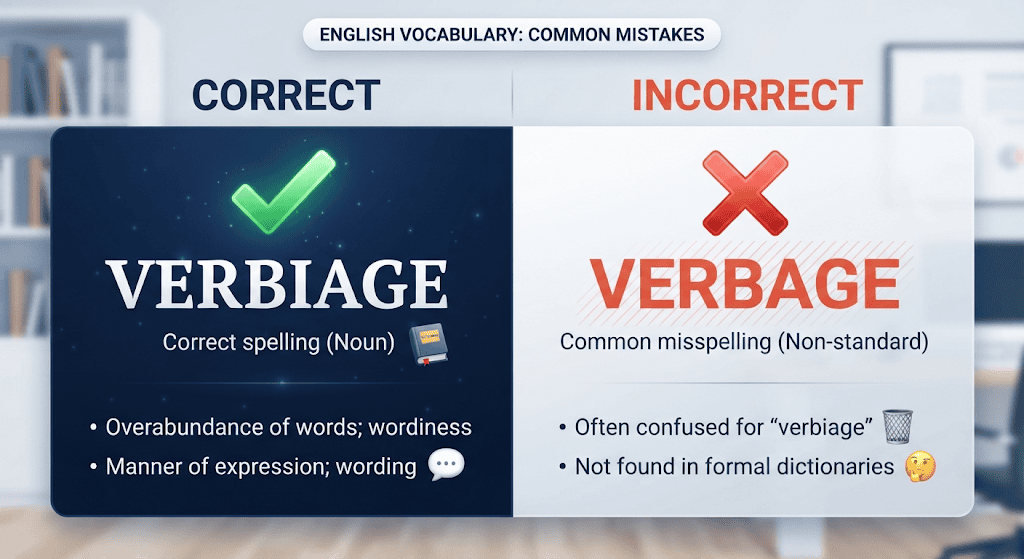
Have you ever stared at a sentence, frozen because you couldn’t quite tell if you were spelling a common word right? When it comes to verbiage vs verbage, even seasoned writers and professionals occasionally trip up.
Let’s clear the air right away: only one of these terms actually exists in the English dictionary. Navigating tricky spelling variations can be frustrating, but understanding the correct choice will instantly elevate your professional writing and keep your communication sharp.
What is Verbiage? (The Only Correct Choice)
If you are looking for the legitimate, dictionary-approved term, verbiage is your winner.Derived from French, it is a noun with a couple of closely related definitions:
- Excessive Wordiness:Speech or writing that uses far too many words than necessary to get a point across, often feeling dense or obscure.
- Style of Expression:The way someone chooses to phrase things, or the specific wording used in a document (such as legal verbiage in a contract).
Real-World Examples:
- “The legal verbiage in the software agreement was so dense that nobody wanted to read it.”
- “Please cut down the unnecessary verbiage so our readers can grasp the core message quickly.”
Where Did “Verbage” Come From?
So, what about verbage? Is it just an alternative spelling?
Put simply, verbage is a common misspelling.While it pops up frequently in informal emails, drafts, and casual text messages, it is considered a non-standard word or an accidental blend of “verb” and “garbage”.
- Is it accepted? Mainstream dictionaries and style guides do not recognize it as a valid spelling.
- Should you use it?Absolutely not. Using verbage in a resume, academic paper, or professional email can easily undermine your credibility.
Quick Tricks to Remember the Difference
Because spelling slip-ups happen to the best of us, having a quick mental trick up your sleeve helps. Try these simple strategies to ensure you never misspell it again:
- The “I” Rule: Think of the correct spelling containing the word “age” tucked right in the middle: verb-i-age.
- The Mnemonic Device:Remember the phrase, “Verbage is garbage”. If it sounds like a made-up word associated with trash, keep it out of your formal writing!
Frequently Asked Questions
Is “verbage” a real word?
No. Verbage is classified as a non-standard misspelling.The correct and only accepted spelling is verbiage.
Does verbiage always have a negative meaning?
Traditionally, verbiage implies wordiness or an overabundance of fluff.However, it is also widely accepted as a neutral term referring simply to the wording or style of a text.
How do you properly pronounce verbiage?
It is pronounced as VER-bee-ij (with the primary emphasis on the first syllable, ending in an “-ij” sound).
Conclusion
At the end of the day, the debate between verbiage vs verbage has a clear-cut answer: stick to verbiage to keep your writing polished, authoritative, and error-free. Mastering small vocabulary details like this goes a long way in building strong communication skills.
Want to sharpen your writing even further? Explore our other deep-dives into commonly confused words and grammar rules to take your content to the next level!