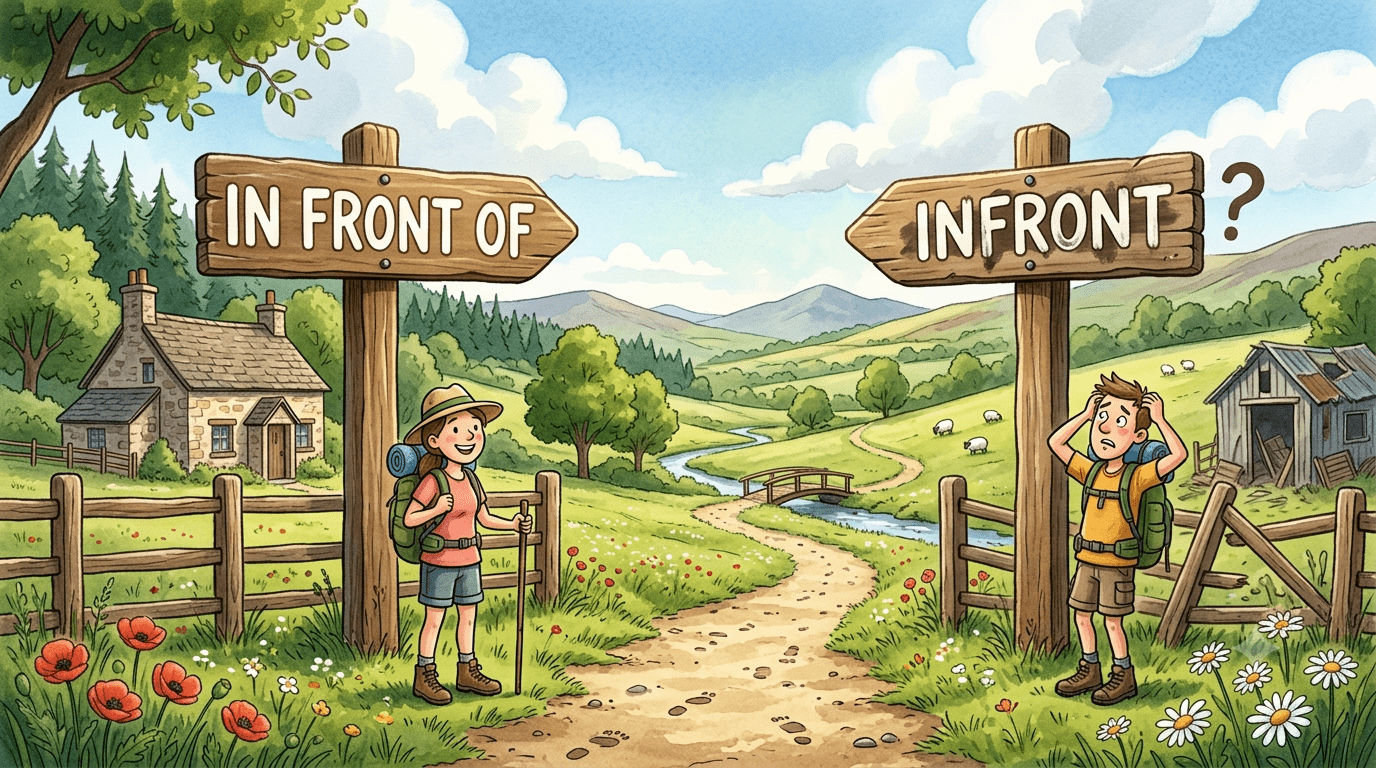
Do you ever stop and wonder if you should write “infront or in front“? It is a super common question! Many people get these two mixed up because they sound exactly the same when we talk. However, in writing, there is only one correct way to do it. Learning the right way will make your writing look much sharper and more professional. Let’s dive into this simple grammar rule together and clear up the confusion once and for all.
The Short Answer: What is Correct?
If you are looking for the right term, the answer is always in front. You should always use two separate words. The word “infront” is actually a spelling mistake. It is not a real word in the English language! When you want to describe a location, remember to keep a space between the words. Think of it like a pair of shoes; they go together, but they stay separate. Using “in front” correctly helps your sentences sound clear and natural. It is a quick fix that instantly improves how your writing looks to others.
Why Do People Get Confused?
Language can be tricky! We often see words like “inside,” “into,” or “instead.” Because those words are combined, it is very natural to think that “infront” should be one word too. It follows a pattern that makes sense to our brains. But English has many exceptions, and this is one of them. While “inside” works, “in front” stays as two distinct words. It is helpful to remember that “front” is a noun here, and “in” is a preposition. They act as a phrase to tell us where something is located. Once you realize it is just a common habit, it gets easier to avoid the mistake!
Using “In Front” as a Preposition
When we use “in front of,” we are talking about a location relative to something else. For example, you might say, “The dog is standing in front of the house.” Here, the dog is in a specific spot compared to the building. This phrase is perfect for showing placement or order. Whenever you are trying to say where an object or a person is, “in front” is your go-to choice. Using it correctly helps the reader picture exactly what you are seeing in your mind. It is a very useful tool for descriptive writing!
Common Mistakes to Avoid
The biggest mistake is definitely sticking the words together as “infront.” Even though it looks like it could be a word, it just isn’t. Another mistake is using it without the word “of” when you are comparing two things. If you say, “He is sitting in front me,” it sounds incomplete. You really need that “of” to connect the ideas. Always check your sentence to see if “of” is needed to make the meaning clear. Taking an extra second to look for that small word can save you from a common grammatical error.
Examples of Correct Usage
Let’s look at how to use the phrase in your daily writing. You can use it when talking about lines: “Please stand in front of the line.” You can use it for people: “The teacher stood in front of the class.” You can even use it for cars: “My car is parked in front of the store.” These examples show how natural and easy it is to use. Just remember to put that little space between the two words. Once you practice a few times, you will start doing it without even thinking about it!
Is “Infront” Ever Used?
You might wonder if “infront” is used in any special cases. The answer is simply no. You will not find it in a dictionary as a correct word. If you see it written, it is almost certainly a typo. Some people use it in informal text messages or quick social media posts, but it is better to avoid it everywhere. Using the correct spelling shows you care about your writing. Whether you are writing a school report or just an email to a friend, using “in front” is always the best way to go.
Biography Table: Keeping Things Organized
Sometimes, keeping track of grammar rules feels like keeping track of a busy life. If we imagine grammar as a person, we can see how they organize their skills. Here is a fun way to look at how we master these concepts.
| Skill Level | Grammar Focus | Action Taken |
| Beginner | Identifying words | Learning “in front” vs “infront” |
| Intermediate | Sentence structure | Writing clear descriptions |
| Expert | Advanced flow | Teaching others the rules |
Tips for Better Writing
Improving your writing is all about practice and patience. Start by reading more books or stories you enjoy. When you see phrases like “in front,” take note of how they are used. This helps you get used to the correct spelling naturally. Also, try reading your own work out loud. Your ears are great at catching mistakes that your eyes might miss. If you read a sentence and it feels a bit clunky, rephrase it. Writing is a journey, and every little step makes you a better communicator.
The Role of “Front” as an Adjective
Sometimes, “front” acts differently in a sentence. We might say, “The front door is open.” Here, “front” is an adjective describing the door. It is not part of a prepositional phrase, so it stands alone. This is different from “in front,” which needs the “in.” Understanding the job each word does makes grammar much less scary. Just ask yourself: “Am I describing a location, or am I describing an object?” That simple question usually tells you exactly which word to pick. You have the power to master these small details!
Why Clarity Matters
Why do we care so much about grammar? It’s because we want to be understood! When we write clearly, our ideas shine through without any distractions. If a reader sees a misspelled word like “infront,” they might stop and wonder about the meaning. We want to keep them focused on our great ideas instead. Clear, simple, and correct writing creates a bridge between you and the person reading your work. It is a sign of respect for your reader and shows that you take pride in what you share.
Practice Makes Perfect
Do you want to get really good at this? Try writing five sentences right now using “in front.” Write about things in your room, your school, or your neighborhood. For example: “My backpack is in front of my desk.” Or, “The big tree is in front of the park.” The more you write, the more natural it will feel. Don’t worry about being perfect right away. Even the best writers in the world had to learn these rules at one point. Just have fun with it and keep writing!
Frequently Asked Questions (FAQs)
1. Is “infront” ever acceptable?
No, “infront” is not a correct word in the English language. It is a common spelling error.
2. Should I always use “in front of”?
You should use “in front of” when you are describing a location relative to another object. If you just mean the front part of something, you might just use the word “front” as an adjective.
3. Is there a difference between “in front” and “in front of”?
Yes! “In front” acts as an adverb, like “He stood in front.” “In front of” acts as a preposition, like “He stood in front of me.”
4. How can I remember the difference?
Remember that “front” is a noun. You wouldn’t say “inhouse” or “inroom,” so you shouldn’t say “infront.” Keep the words separate!
5. Does it matter if I use the wrong one?
In formal writing, it definitely matters! Using the correct spelling helps you look professional and makes your writing much easier for others to read.
6. Where can I find more grammar tips?
You can look at helpful websites like dictionaries or grammar guides. Practicing with friends or teachers is also a fantastic way to learn more!
Final Thoughts
Writing is an amazing way to share your world. By mastering little details like choosing “in front” over the incorrect “infront,” you are building a strong foundation. You are now ready to write sentences with confidence and clarity. Don’t let these small rules stop you; use them as tools to become a stronger writer. I hope this guide helped you feel more comfortable. What other grammar questions do you have? Let me know, and we can explore them together!